


Early, aggressive treatment of an underlying inflammatory condition can minimize the extent and severity of post-inflammatory pigment change. Treatment for post-inflammatory hyperpigmentation can be multimodal, including a mix of prescription and non-prescription, topical and oral products.
These were some clinical pearls on managing hyperpigmentation provided by Dr. Panteha Eshtiaghi during a presentation at the 2025 Skin Spectrum Summit: Focus on Women.
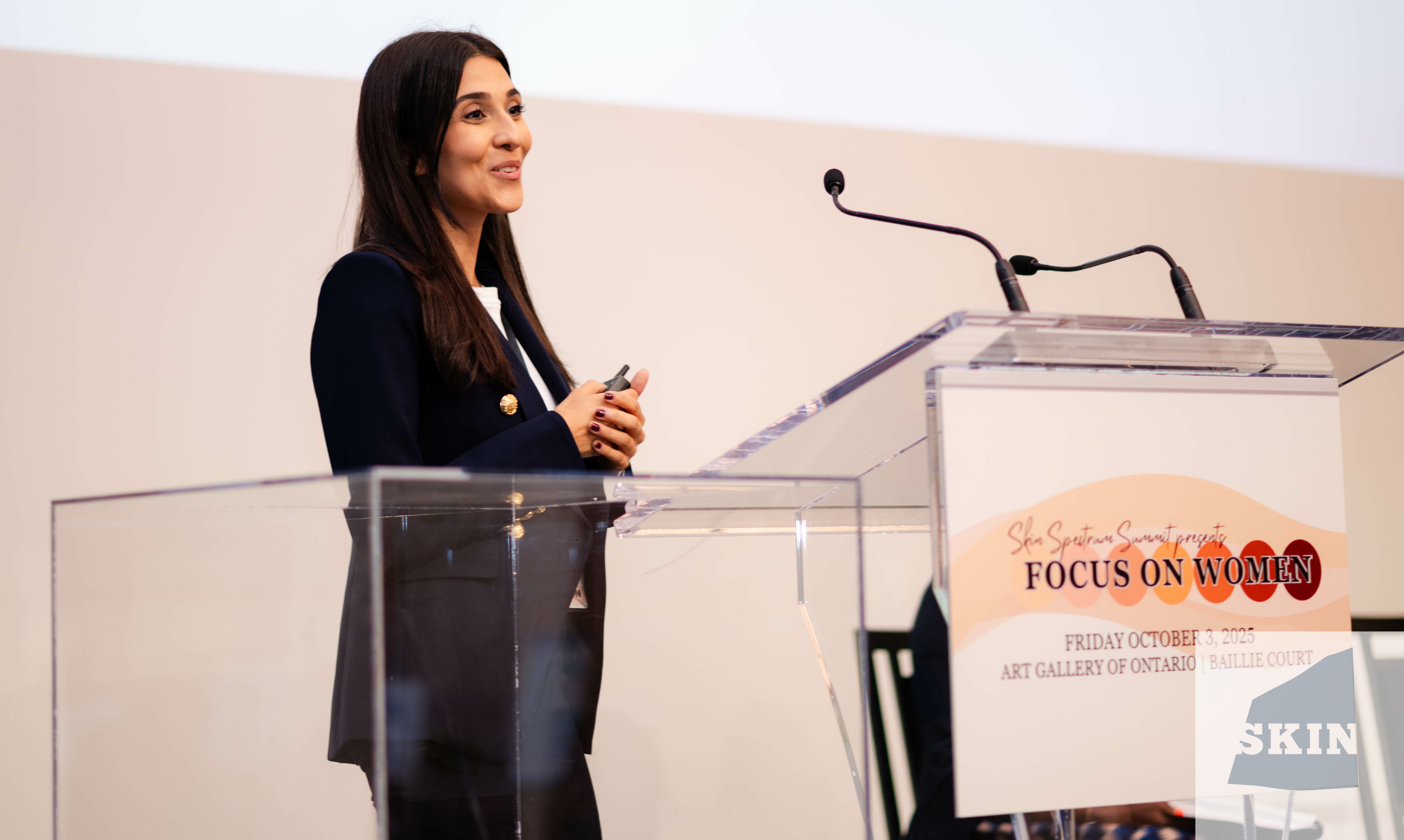
Toronto-based dermatologist Dr. Eshtiaghi serves on the Board of Directors of the Eczema Society of Canada, where she contributes as a medical advisor on patient-facing educational resources and national survey data. Her academic work has emphasized patient education and public health outreach, with a particular focus on increasing awareness and improving access to care for patients with chronic inflammatory skin conditions.
Dr. Eshtiaghi said she reserves hydroquinone for acute management of pigmentation following other procedures, such as the removal of seborrheic keratoses. This choice is due to hydroquinone’s potential for irritation, how quickly compounded products can expire, and the side effects of long-term use, such as ochronosis. She said topical cysteamine is a good alternative to hydroquinone for longer-term use.
Working from a “toolbox” of prescription and non-prescription products, Dr. Eshitaghi said she works with patients to develop a treatment approach that meets their specific needs and goals.
Prescription products in that toolbox include hydroquinone, retinoids, azelaic acid gel 15%, compounded glutathione cream 5%, and oral tranexamic acid.
Dr. Eshitaghi said that during her residency, she was concerned about oral tranexamic acid due to hearing about the risk of clotting associated with the medication. However, that concern was alleviated when she compared the use of oral tranexamic acid in dermatology to its gynecologic use.
“TxA [tranexamic acid] is used for clotting in gynecology for women who have heavy menstrual periods,” she said. In that indication, women are prescribed 1.5 g orally, three times a day, for seven days in the month, which is 31.5 g total for the month. In dermatology, the dosing is often 500 mg daily for the entire month, totalling 15 g.
“So [the dosing] is much lower than is widely used in gynecology for menorrhagia, and [dermatologists] also use it in short, three-to-six-month cycles.”
Non-prescription products in Dr. Eshitaghi’s toolbox include topical cysteamine (15 minutes a day for four months, then two or three times a week), Polypodium leucotomos (one capsule twice a day, especially April to September), in-office procedures such as chemical peels and energy devices, and cosmeceuticals.
She noted there is good evidence in the literature supporting the tyrosinase inhibitor Thiamidol (isobutylamido thiazolyl resorcinol), but the medication is not yet available in Canada.
Bottom line: Aggressive treatment of underlying inflammation reduces the extent and severity of hyperpigmentation. There are many effective prescription and non-prescription agents for managing hyperpigmentation, so a tailored treatment approach can be developed to meet a patient’s treatment goals and tolerances. While there are some concerns about clotting risk with oral tranexamic acid, dermatologists can be reassured by the lower doses they prescribe compared to gynecologic indications, which are considered reasonably safe.

From the literature on dermatology in skin of colour
A pilot randomized split-face trial comparing fractional Q-switched ruby laser and 1,064-nm Q-switched Nd:YAG laser in Chinese women with melasma
Researchers compared the clinical efficacy, safety, and patient-reported outcomes of fractional Q-switched ruby laser (fQSRL) and the Q-switched 1,064-nm Nd:YAG laser (QSNY) in the treatment of melasma in skin of colour.
In this randomized, assessor-blinded, split-face study, 21 Chinese women with Fitzpatrick skin types III-IV and bilateral melasma received three to six treatment sessions with fQSRL and QSNY, administered at three-week intervals.
Both lasers achieved a 62.0% response rate, with no significant difference in hemi-mMASI score reduction (p>0.05). Patient satisfaction scores were similar between treatments. However, pain scores were significantly higher with fQSRL than with QSNY (p<0.0001). Post-inflammatory hyperpigmentation occurred bilaterally in one patient (4.8%), with no serious adverse events reported.
The authors say that more large-scale, multicentre studies are needed to confirm long-term efficacy and safety.

Topical prevention from high-energy visible light-induced pigmentation by 2-mercaptonicotinoyl glycine, but not by ascorbic acid antioxidant: 2 randomized controlled trials
Investigators assessed two non-tinted active agents—ascorbic acid 7% and 2-mercaptonicotinoyl glycine (2-MNG) 0.5% or 1%—in counteracting high-energy visible light (HEV)-induced pigmentation in two clinical trials.
In total, 58 individuals with Fitzpatrick skin phototype III or IV were included.
Researchers exposed delineated areas on the subject’s back, either topically treated with the test product or left untreated, to HEV once a day for four days. The product was applied before, during, and five weeks after HEV exposure. Investigators assessed pigmentation using chromametry and visual scoring throughout the studies.
While ascorbic acid did not exhibit efficacy versus its vehicle in limiting HEV-induced skin hyperpigmentation, the use of 2-MNG (0.5 or 1%) led to an early, significant decrease in HEV-induced pigmentation, which was sustained until the end of the study. Moreover, a 2-MNG dose effect could be evidenced at early time points.
The authors conclude that 2-MNG represents an efficient and transparent alternative to pigments for mitigating HEV-induced worsening of hyperpigmentation. This opens up perspectives for its use as a complement to the UV protection afforded by sun filters.
Utilizing internal hemostatic nets for rhytidectomy in Fitzpatrick skin types III to V
In this paper, the authors demonstrate the efficacy of internal quilting sutures (IQS) in rhytidectomy in patients with darker skin types.
Forty-one individuals (six males, 35 females, mean age: 55 years) with Indian or Middle Eastern ethnicity and Fitzpatrick skin type III to VI underwent facelift surgery between February 2019 and October 2024. Physicians performed the platysma superficial musculoaponeurotic system plication facelift procedure. They then applied IQS using 4-0 Vicryl, between subcutaneous tissue and skin. Researchers recorded patient demographic data, details of the procedure, early complications including hematoma, necrosis, bruising, nerve palsy, and late complications like skin dimpling, seroma, and sialorrhea.
With a mean follow-up duration of 37.2 months, investigators recorded no cases of hematoma or seroma. There was one case of dehiscence in a smoker patient with diabetes. Researchers observed transient dimpling in seven patients, and two patients developed dog-ears; both were resolved conservatively.
In their conclusion the authors write that in rhytidectomy, visibility of sutures and increased risk of dyspigmentation at needle puncture sites due to the use of an external hemostatic net can be distressing. IQS maintain the benefits of external hemostatic nets—such as reducing skin tension and enhancing redraping—without its disadvantages, resulting in more natural and lasting outcomes, especially for patients with thicker skin and higher Fitzpatrick skin types.

VIDEO: Skin of Colour Savvy: Insights on hyperpigmentation from EADV, with Michelle Rodrigues, MBBS
Michelle Rodrigues, MBBS, dermatologist, discusses her presentation at the Skin of Color Society’s (SOCS) symposium at the 2025 European Academy of Dermatology and Venereology meeting in Paris, titled “Unmasking Facial Hyperpigmentation in Richly Pigmented Skin Types.” Dr. Rodrigues, the founder and director of the Pigment and Skin of Colour Centre at Chroma Dermatology in Australia and an associate professor at the University of Melbourne, offers practical insights for clinicians managing these disorders.
At the intersection of skin and society
Hockey Canada has announced the 11 representatives appointed to the organization’s first Indigenous Advisory Circle (IAC), which will guide efforts to advance reconciliation with Indigenous Peoples through sport, reports TSN.
The IAC will help inform organizational policies, programs and practices related to the Truth and Reconciliation Commission’s Calls to Action and other initiatives that will advance Hockey Canada’s work with Indigenous peoples.
Dr. Wilton Littlechild, a Companion of the Order of Canada and Canada’s Sports Hall of Fame inductee, is the circle’s inaugural chair.
Dr. Littlechild is joined by 10 other representatives:
Kalley Armstrong (Kitigan Zibi Anishinabeg, Que.)
Trechelle Bunn (Birdtail Sioux Dakota Nation, Man.)
Kateri Coade (Abegweit First Nation, P.E.I.)
Kyanna Coe (Prince George, B.C.)
Breanne Dondo (Red River Métis Nation, Man.)
Ryan Francis (Wasoqopa’q First Nation, N.S.)
Ava Hill (Six Nations of the Grand River, Ont.)
Laura McPhie (Pikwakanagan First Nation, Ont.)
Kevin Monkman (Ebb and Flow First Nation, Man.)
Patrick Twinn (Sawridge First Nation, Alta.)
In August 2023, Hockey Canada published its first Equity, Diversity and Inclusion (EDI) Path Forward, which included a Commitment to Action statement that summarized the ongoing work to drive long-term, sustainable change within hockey, as well as actions that relate to respecting, protecting and promoting the rights and opportunities of Indigenous Peoples through sport.
Integrating Inclusion, a refreshed version of the EDI Path Forward, is expected to be distributed later in 2025.
This week
November is National Healthy Skin Month in the U.S.
November is Indigenous Disability Awareness Month in Canada
Nov. 16 is International Day for Tolerance
Something to think about in the week ahead . . .

—George Eliot, (1819-1880), British author
Next week
Dr. Monica Li (Vancouver) discusses the presentation and management of acne sequelae across skin types in a presentation at the 2025 Skin Spectrum Summit in Toronto.
Join your colleagues for the 2nd Annual Acne Summit
On Saturday, November 29, this half-day live panel discussion and virtual learning experience will feature leading dermatologists, general practitioners, and skin health experts from across Canada.
Chaired by Dr. Geeta Yadav (Toronto) and Dr. Jerry Tan (Windsor, Ont.), this year’s Summit will explore the latest innovations in acne diagnosis and treatment, with a focus on inclusive care and reducing healthcare disparities..
Here’s what to expect:
Cutting-edge therapeutic updates for all acne severities
Best practices for diagnosing acne in individuals with skin of colour
Practical resources to support patients and caregivers
In-depth discussions addressing gaps in dermatologic training and access
Date: Saturday, November 29, 2025
Time: 1:00 PM – 4:30 PM ET
Location: Zoom (Virtual)
Cost: No Charge to Attend
If you enjoy Skin Spectrum Weekly, why not check out the Chronicle’s other publications, podcasts, and portals?
Established in 1995, The Chronicle of Skin & Allergy is a scientific newspaper providing news and information on practical therapeutics and clinical progress in dermatologic medicine. The latest issue features:
Pediatric dermatologist Dr. Sheilagh Maguiness (Minneapolis) discusses the current state of treatment for vascular anomalies, including infantile hemangioma.
Drs. Charles Lynde (Markham, Ont), Carolyn Jack (Montreal), and Julien Ringuet (Quebec City) review expanded therapeutic options becoming available in 2025.
Drs. Jessica Asgarpour (Toronto), Brittany Waller (Toronto), Maxwell Sauder (Toronto), and Se Mang (Simon) Wong (New Westminster, B.C.) provide an update on what’s new in hidradenitis suppurativa in 2025.
Plus regular features, including the popular column “Vender on Psoriasis” by dermatologist Dr. Ron Vender.

You can read a recent digital edition of The Chronicle of Skin & Allergy here. To apply for a complimentary subscription or to request a sample copy, please email health@chronicle.org with your contact information.
The Women in Dermatology e-newsletter updates readers with new findings concerning dermatologic issues affecting women and the female dermatologists who care for them. Read the current issue here.
Season three of the Vender on Psoriasis podcast, featuring Dr. Ron Vender, has begun. Listen to the new season here. In episode five, Dr. Vender discusses whether vitamin D influences the severity of psoriasis, sex differences in psoriatic inflammation and itch, and the risk of psychiatric disorders associated with acitretin.
And if you’re looking for a web destination for all things derm, visit derm.city, “Where Dermatology Lives.” Please like, rate, review, and share it with your colleagues.